Tarotoop

I Ching Online: Toss the Coins, Read Your Hexagram

Cast the I Ching online the traditional way: hold one question in mind, toss three coins six times, and watch your hexagram build from the bottom up. Your changing lines and relating hexagram are worked out for you, so your free I Ching reading starts with the meaning, not the math.

One situation, in your own words. Keep it in mind while you toss.

323

Heads = 3, tails = 2. The sum gives each line.

Line 1 of 6

  1. Line 1
  2. Line 2
  3. Line 3
  4. Line 4
  5. Line 5
  6. Line 6

Lines are built from the bottom up.

How to cast the I Ching online

1

Hold one question

Before you touch the coins, settle on a single question and type it in. Read it back to yourself slowly, because no coin can sharpen a blurry question for you. If three worries are elbowing for attention, pick the one most likely to keep you up tonight.

2

Toss the coins six times

Each toss uses three coins: heads count 3 and tails count 2, so every throw adds up to 6, 7, 8, or 9. That total becomes one line (a 7 or 9 is a solid yang line, a 6 or 8 a broken yin line), and the hexagram grows from the bottom up, so your first toss is the lowest line and your sixth is the top. Take a breath between throws if it helps you stay with your question.

3

See your hexagram and changing lines

After the sixth toss, you'll see your primary hexagram with any changing lines, the 6s and 9s, clearly marked. If you have changing lines, you'll also see the relating hexagram they turn into; if you don't, your single hexagram is the whole answer.

4

Ask Geumeum or read on your own

For a personalized reading, ask our resident reader to tie the hexagram, the changing lines, and the relating hexagram back to what you actually asked, with a clear next step. Prefer to interpret it yourself? Open the hexagram's own page for its judgment, image, line-by-line meanings, and notes on love and work.

How to read your hexagram

Your primary hexagram is a snapshot of your situation as it stands right now. Its name gives you the theme in a word or two, its judgment sums up the moment and what it rewards, and its image, the picture formed by its two trigrams, suggests the attitude that fits. Start here, and read it slowly against your question before you look at anything else. People are often surprised by how precisely a hexagram like Waiting or Conflict names what they're going through, and that moment of recognition becomes the anchor for the rest of the reading.

Changing lines are the throws that came up 6 or 9. A 6 is old yin and a 9 is old yang: each has reached its extreme, the way midsummer already carries the turn toward winter, so it's about to flip into its opposite. A 7 (young yang) or an 8 (young yin) is stable and stays as it is. That's why changing lines matter so much. They point to the exact places where your situation is already in motion, and their line texts usually hold the most specific, personal advice in the whole cast, whether that's "hold back for now" or "this is the moment to speak up."

Flip every changing line into its opposite and you get the relating hexagram. Think of it as the direction things are moving in, where the current pattern tends to lead if it plays out, rather than a verdict waiting at the end of the road. Often the most revealing part of a reading is the bridge between the two hexagrams: what changes, what stays the same, and what you could do to steer the shift. If none of your lines are changing, there's no relating hexagram, and your primary hexagram speaks on its own. The traditional rules below, in simplified form, show which text to focus on for each number of changing lines.

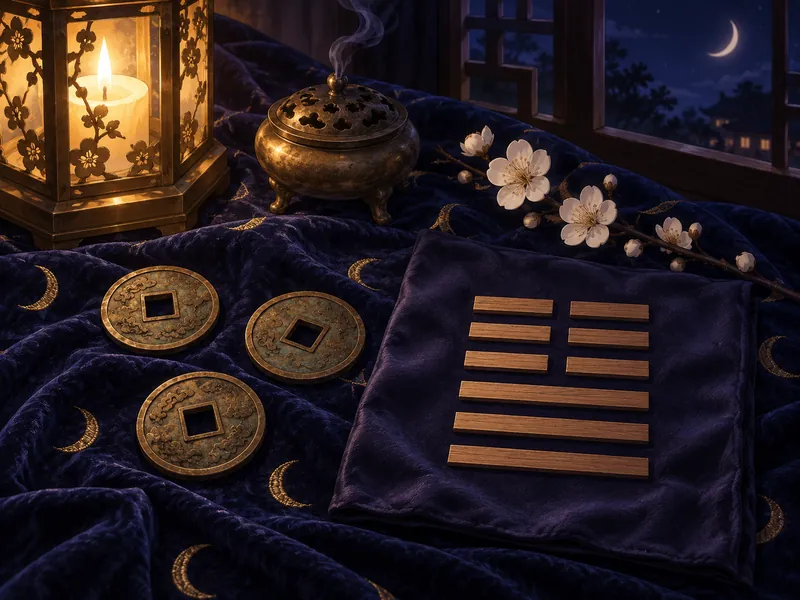
Which text to read: the changing-line rules

0 changing lines
Read the judgment of your primary hexagram, with its image as a helpful extra. Nothing in the situation is moving yet, so the hexagram as a whole is your answer.
1 changing line
Read the text for that one line in your primary hexagram. It's the focal point of the whole cast, so give it the most weight.
2 changing lines
Read both changing lines in your primary hexagram, and let the upper one lead. The lower line adds context, while the upper line carries the main message.
3 changing lines
Read the judgments of both hexagrams, the primary first and then the relating one. With half the lines in motion, the answer lies in the shift from one situation to the next.
4 changing lines
Turn to the relating hexagram and read its two lines that did not change, letting the lower one lead. When most of the picture is moving, the lines that hold steady show you what you can rely on.
5 changing lines
Read the one unchanged line in the relating hexagram. When almost everything is shifting, that single steady line is your clearest guidance.
6 changing lines
If you cast Qian (hexagram 1), read its special text for all six lines changing, known as "Using Nines"; if you cast Kun (hexagram 2), read its "Using Sixes" text. For any other hexagram, read the judgment of the relating hexagram, since the whole situation is turning into its opposite.

How to ask the I Ching a good question

A good question starts with one situation. "What about my love life and my career?" is really two questions, and you'll get a muddier answer to both. Name the person, project, or choice you're actually facing, and add a line of context if it helps you focus: "My sister and I haven't really talked since the wedding" gives the hexagram something real to land on. Plain, honest words work best; there's no special phrasing the I Ching prefers.

Next, favor open questions that start with "how" or "what." Because the I Ching describes situations and offers advice, "How can I…" and "What do I need to understand about…" draw out far more than "Will he text me?" If you truly need a yes or no, go ahead and ask, but read the answer as a lean, not a ruling. Finally, give your question a time frame, such as the next three months or the rest of this year, so you know which stretch of your life the answer belongs to.

  • What do I need to understand about where things are heading with Jordan?
  • How can I make the most of my first six months at this new job?
  • What should I weigh before deciding whether to move to Denver next year?
  • How can I repair things with my mom after our fight at Thanksgiving?
  • What's keeping me stuck right now, and how can I start moving again?

I Ching, tarot, or a yes/no reading?

Reach for the I Ching when you're dealing with a process rather than a single moment: a relationship that's shifting, a career at a crossroads, or a decision whose effects will unfold over months. Its specialty is timing and attitude. A hexagram tells you whether the moment calls for pushing ahead, waiting, holding steady, or letting go, and the changing lines show which way things are turning. It's also refreshingly frank about your own part in the story, which isn't always what you want to hear but is usually what you need to.

A tarot spread is the better fit when you want a detailed, layered picture, with separate cards for you, the other person, the obstacle, and the likely outcome, plus rich imagery to sit with. A yes/no tarot reading is the quick option when the question is simple and you just want a lean. They also work well together: a yes/no card for the gut check, then the I Ching for the deeper why and the wisest way to act.

All 64 I Ching hexagrams

Pick any hexagram to read its judgment, image, line-by-line meanings, and what it says about love and work.

  1. #1Qian, The Creative
  2. #2Kun, The Receptive
  3. #3Zhun, Difficulty at the Beginning
  4. #4Meng, Youthful Folly
  5. #5Xu, Waiting
  6. #6Song, Conflict
  7. #7Shi, The Army
  8. #8Bi, Holding Together
  9. #9Xiao Chu, Taming Power of the Small
  10. #10Lü, Treading
  11. #11Tai, Peace
  12. #12Pi, Standstill
  13. #13Tong Ren, Fellowship
  14. #14Da You, Great Possession
  15. #15Qian, Modesty
  16. #16Yu, Enthusiasm
  17. #17Sui, Following
  18. #18Gu, Repairing What Is Spoiled
  19. #19Lin, Approach
  20. #20Guan, Contemplation
  21. #21Shi He, Biting Through
  22. #22Bi, Grace
  23. #23Bo, Splitting Apart
  24. #24Fu, Return
  25. #25Wu Wang, Innocence
  26. #26Da Chu, Taming Power of the Great
  27. #27Yi, Nourishment
  28. #28Da Guo, Great Excess
  29. #29Kan, The Abysmal
  30. #30Li, The Clinging Fire
  31. #31Xian, Influence
  32. #32Heng, Duration
  33. #33Dun, Retreat
  34. #34Da Zhuang, Great Power
  35. #35Jin, Progress
  36. #36Ming Yi, Darkening of the Light
  37. #37Jia Ren, The Family
  38. #38Kui, Opposition
  39. #39Jian, Obstruction
  40. #40Jie, Deliverance
  41. #41Sun, Decrease
  42. #42Yi, Increase
  43. #43Guai, Breakthrough
  44. #44Gou, Coming to Meet
  45. #45Cui, Gathering Together
  46. #46Sheng, Pushing Upward
  47. #47Kun, Oppression
  48. #48Jing, The Well
  49. #49Ge, Revolution
  50. #50Ding, The Cauldron
  51. #51Zhen, The Arousing Thunder
  52. #52Gen, Keeping Still
  53. #53Jian, Gradual Progress
  54. #54Gui Mei, The Marrying Maiden
  55. #55Feng, Abundance
  56. #56Lü, The Wanderer
  57. #57Xun, The Gentle Wind
  58. #58Dui, The Joyous Lake
  59. #59Huan, Dispersion
  60. #60Jie, Limitation
  61. #61Zhong Fu, Inner Truth
  62. #62Xiao Guo, Small Excess
  63. #63Ji Ji, After Completion
  64. #64Wei Ji, Before Completion

All 64 hexagrams

I Ching reading FAQ

Is this I Ching reading free?

Yes. You can toss the coins, see your primary hexagram, changing lines and relating hexagram, and read the meanings of all 64 hexagrams without paying or signing up. When you ask Geumeum to read your hexagram, the opening of her answer is free too; the full personal reading is 10 credits. A free account comes with 10 credits, enough for your first full reading.

Is an online coin toss as valid as real coins?

In the way that matters, yes. The method is the same (three coins, heads 3 and tails 2, six throws from the bottom up), and each virtual coin has an even chance of landing either way, so every line comes up with exactly the odds it would at your kitchen table. In the I Ching tradition, what gives a casting meaning is the sincerity of your question and the attention you bring, not whether the coins are brass or pixels.

How often can I ask the I Ching?

You can cast whenever you have a real question. The tradition asks one thing, though: don't keep repeating the same question until you get an answer you like. Hexagram 4, Youthful Folly, says it plainly: the first asking gets an answer, but pestering gets none. Ask again when the situation has actually changed, or when you come at it from a genuinely new angle.

What do changing lines mean?

Changing lines are the throws that added up to 6 (old yin) or 9 (old yang). They're lines at their extreme, about to turn into their opposite, so they mark the parts of your situation that are already in motion. Their texts usually carry the most specific advice in a reading, and flipping them gives you the relating hexagram.

What if I get no changing lines?

Then your answer is one steady hexagram, and you read its judgment, with the image as a bonus. It usually means the situation is settled for now, and the advice is to work with the pattern you're in rather than wait for it to shift. It happens in roughly one cast out of six, and it's one of the clearest answers you can get, not a weaker one.

Can the I Ching predict the future?

Not as fixed fate, and it never really claimed to. It's called the Book of Changes for a reason: a hexagram describes the pattern your situation is in, where that pattern tends to lead if nothing shifts, and how to respond well. Your choices still shape what happens, so treat a reading like a weather forecast with good advice attached, not a verdict on your life.