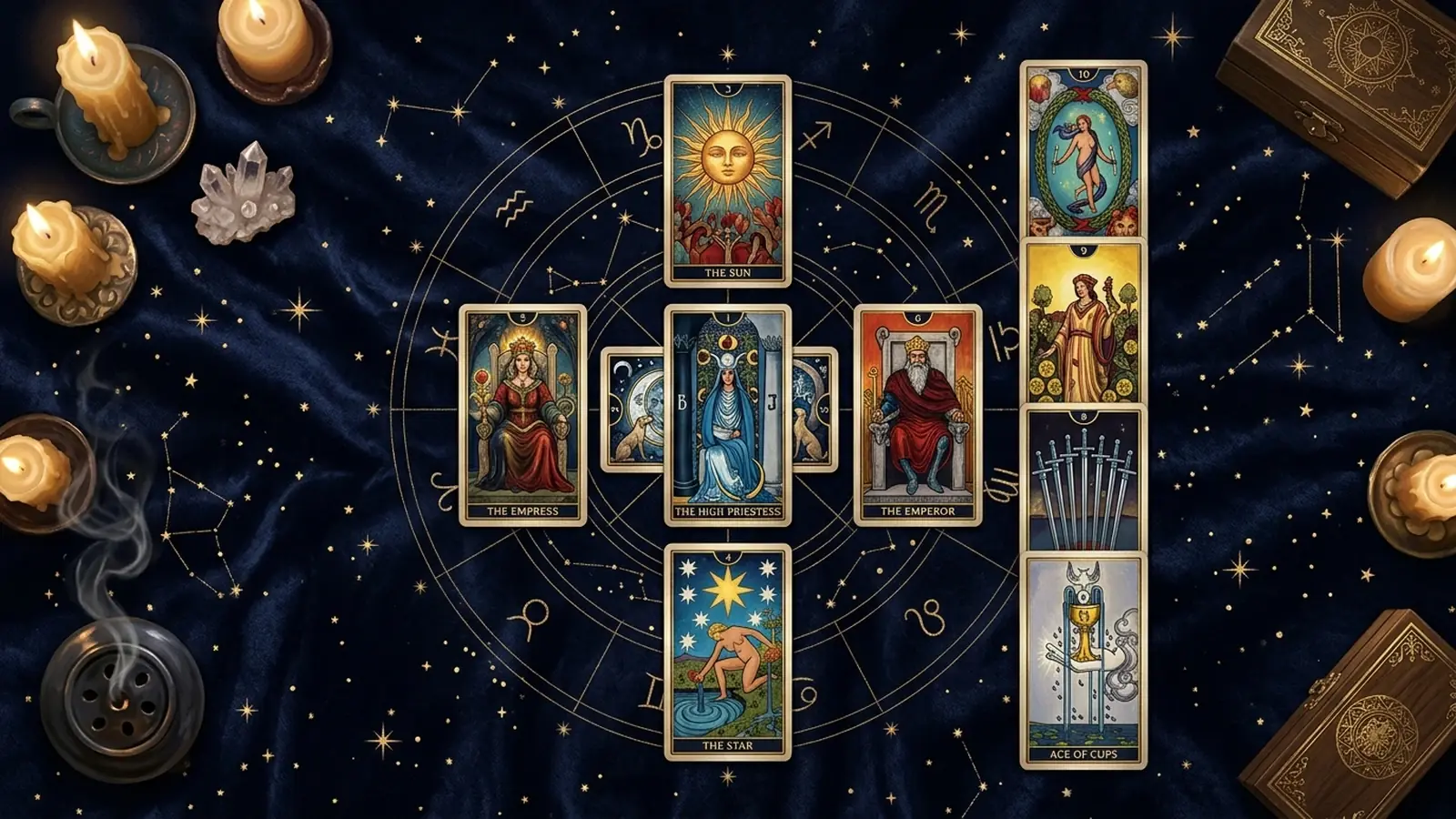
Celtic Cross Spread
Ten cards form a cross and staff to show the present, challenge, background, outside influences, and final outcome.
How the Celtic Cross spread works
The Celtic Cross is a ten-card tarot spread for one complicated situation: six cards in a cross describe the situation itself, and four cards in a column beside it describe you, the people around you, your hopes and fears, and the likely outcome. Read each card in its position first, then read the cross and the column as two short stories and connect them.
On this page you write your question, draw ten cards from the full 78-card deck (upright and reversed), and the AI reader Geumeum reads every card in its position for your question. The last card shows the direction things tend to take if nothing changes, not a fixed fate.
When to use the Celtic Cross
Use the Celtic Cross when one situation has several moving parts: a relationship at a turning point, a job decision that affects home life, or a problem you keep circling without seeing why. Ten positions give each part its own place, so the reading can separate what is happening from what you fear is happening.
For a quick lean on a simple question, a yes or no reading is a better fit, and for choosing between two or three concrete paths, the Two Options spread compares them side by side.
The 10 positions on this page
Each position asks a different question about the same situation. These are the names used in your reading:
- 1. Present: the heart of the situation as it stands now.
- 2. Challenge: what crosses you, the main obstacle or tension.
- 3. Subconscious: what sits underneath, often a feeling or motive you have not named.
- 4. Recent past: what has just happened and is still shaping things.
- 5. Conscious goal: what you are aiming for, or think you want.
- 6. Near future: what is likely to come up next, in the coming weeks.
- 7. Self attitude: how you are approaching the situation.
- 8. External environment: other people and circumstances around you.
- 9. Hopes & fears: what you hope for and dread, often the same thing seen from two sides.
- 10. Final outcome: where things tend to go if nothing changes.
How to read it in three steps
- Card by card: read each card for what it says in its own position before linking anything.
- The cross, then the column: cards 1 to 6 tell the story of the situation; cards 7 to 10 tell how it meets you and the people around you.
- Connect the two: compare the Conscious goal (5) with Hopes & fears (9), and the Challenge (2) with Self attitude (7). Where they clash is usually where you have the most influence. Read card 10 last.
Using the Celtic Cross for love questions
The Celtic Cross works well for love questions that involve more than “do they like me?”, such as a relationship that keeps stalling or a choice about whether to stay. Write the question about the situation and your next step, for example “What do I need to understand about where this relationship is going over the next six months?” For what one person feels, the 6-card feelings tarot reads both sides more directly.
Where the Celtic Cross comes from
The Celtic Cross became the standard ten-card spread after Arthur Edward Waite published it in The Pictorial Key to the Tarot in 1910, under the title “An Ancient Celtic Method of Divination.” Readers have adjusted the order and position names since, so books and sites sometimes differ slightly; this page uses the ten positions listed above. For a full worked example, see the guide How to read the Celtic Cross spread.
Celtic Cross spread FAQ
What is the Celtic Cross tarot reading for?
The Celtic Cross is for one complicated situation with several moving parts, such as a relationship at a turning point or a decision that affects work and home. For a quick yes or no, or a daily question, one to three cards are a better fit.
How do I read a 10-card Celtic Cross tarot spread?
Read each card in its position first, then read cards 1–6 as the story of the situation and cards 7–10 as how it meets you, other people and the likely direction. Read the final card last, as a direction rather than a fixed outcome.
What questions to ask in Celtic Cross tarot?
Ask one open question about one situation, ideally with a time frame, such as “What do I need to understand about this job change over the next six months?” Several unrelated questions in one spread make the positions hard to read.
Is the Celtic Cross reading free?
Drawing the cards is free and you can start without an account. You get one full reading free, plus two follow-up questions. After that, a reading uses 10 credits and a follow-up question uses 5; credits are bought once, with no subscription.
Can I do a Celtic Cross reading for love?
Yes. The Celtic Cross suits love questions about a whole situation, such as why a relationship keeps stalling or whether to stay. For what one person feels about you, a feelings spread that reads both sides is more direct.
Tarot Fortune
- 2026 Yearly Tarot ReadingUse tarot cards to see the energy of the year ahead and plan with a longer view.
- Seasonal SpreadA five-card reading for the spiritual lessons, energy, relationships, clarity, and wealth of the coming season.
- Monthly TarotDraw three cards for guidance across the early, middle, and late parts of the month.
- Daily TarotExplore today's tarot guidance. One card a day for insight into life's mysteries.
Tarot Spreads
- Celtic Cross SpreadThe classic ten-card spread for your situation, inner conflict, unconscious influences, and future direction.
- Two Options SpreadChoosing between two paths? Reveal the energy and outcome of each route.
- Three Options SpreadFacing three paths? See the potential of each option and find direction.
- Their Feelings TarotA free 6-card reading on what they may feel and where you two stand.
- Reconciliation TarotA free 9-card reading on your breakup, both sides and the way forward.
- Soulmate Tarot ReadingA free 6-card reading on who may be coming, when love tends to show up, and how to meet them.
- Relationship Tarot ReadingA free 5-card reading on where you two stand, what is in the way, and where this is heading.
More to Explore
 Free Online Tarot ReadingWhat this AI tarot reader can do
 Yes or No TarotNeed a quick answer? Ask a yes/no question and let the card decide.
 Love TarotCurious about someone's feelings? Read the attraction and direction in the relationship.
 Tarot Card GeneratorDraw a random tarot card freely and explore each one at your own pace.
 Oracle CardsChoose a deck, hold your question in mind, and draw a card for guidance.
 Tarot ManifestationUse a tarot card as a visual anchor for intention and daily focus.
 Chat with GeumeumThe shop's run by a cat called Mooncake; I just read the cards. You talk, I tell you what's true.
 I ChingToss three coins, cast a hexagram and read its changing lines.
 BaZi calculatorYour free Chinese birth chart: Day Master, Ten Gods and luck pillars.