How to Read the Celtic Cross Spread: All 10 Card Positions Explained
- What each of the ten positions asks, a full example reading, and the mistakes that make it feel confusing
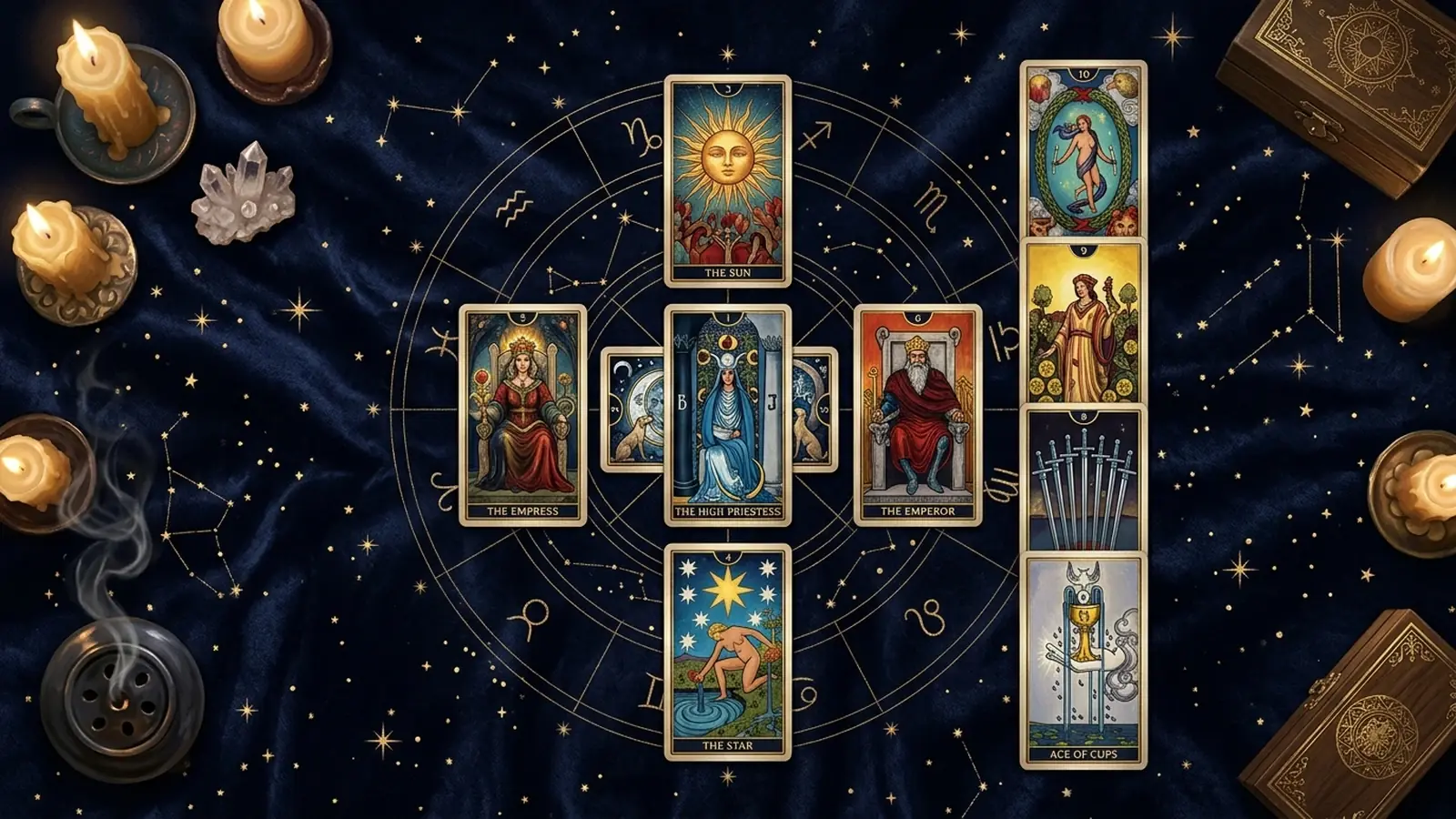
The Celtic Cross is a ten-card tarot spread made of two parts: a six-card cross that describes the situation itself, and a four-card staff beside it that describes you, the people around you and where things are heading. To read it well, read each card in its position first, then read the cross and the staff as two short stories and connect them. The final card shows the likely direction if nothing changes, not a fixed fate.
This guide uses the same ten position names as the Celtic Cross Spread on this site and includes a full example reading.
When the Celtic Cross is the right spread
The Celtic Cross suits complicated questions with several moving parts, and it is overkill for simple ones. Use it when you want to understand a situation from more than one angle: a career change, a relationship at a turning point, a long project that has stalled, or a stage of life you are trying to make sense of.
If your question can be answered with yes or no, a single card or a three-card draw is clearer. If you are choosing between two paths, a comparison spread such as the two options spread is cleaner.
A good Celtic Cross question is open, centered on you and has a rough time frame. "How might the next six months at work develop if I stay?" works better than "Will my boss promote me?", because the first one leaves room for all ten positions to say something useful.
The layout: a cross and a staff
The spread has two parts, and knowing which part a card belongs to tells you what kind of information it carries. In the traditional layout, the first six cards form a cross on the left: one card in the center, one laid across it, then one below, one to the left, one above and one to the right. The last four cards stand in a vertical line on the right, read from bottom to top.
The cross describes the situation: what is happening, what stands in the way, what sits underneath, where it came from, what you are aiming at and what comes next. The staff describes how the situation meets real life: your own stance, other people and circumstances, your hopes and fears, and the overall direction.
The 10 positions explained
Each position asks a specific question, and reading the card as an answer to that question is most of the skill. Here are the ten positions in order.
1. Present
The Present card shows the heart of the situation as it stands now. Read it first and let it set the theme for everything else.
2. Challenge
The Challenge card shows what is pressing against the present, the main obstacle or tension. It is laid across the first card for that reason. A pleasant card here is still a challenge: The Sun in this position might mean too much optimism, or success that brings its own pressure.
3. Subconscious
The Subconscious card shows what is working beneath the surface: motives, needs or fears you may not have put into words. It often explains why the situation feels the way it does. Ask yourself, "Is this something I already sense but have not said out loud?"
4. Recent past
The Recent past card shows what has just happened and is now fading. It shows which part of the situation is already behind you.
5. Conscious goal
The Conscious goal card shows what you are aiming for and thinking about openly. Comparing it with the Subconscious card is one of the most useful moves in the whole spread: when the two agree, you are working with yourself; when they clash, part of you wants something different from what you say you want.
6. Near future
The Near future card shows what is likely to come up next, usually in the coming weeks rather than years. It describes the next step in the situation, not the end of it.
7. Self attitude
The Self attitude card shows how you see yourself in this situation and how you are approaching it. It often reveals confidence, doubt or a role you have slipped into.
8. External environment
The External environment card shows other people, circumstances and pressures outside your control. Read it as context, not as a judgment of anyone's character.
9. Hopes & fears
The Hopes & fears card shows what you are hoping for, what you are afraid of, or both at once. These are often two sides of the same thing: the hope of being chosen and the fear of being left out can sit in one card. Ask which side you feel more strongly when you look at it.
10. Final outcome
The Final outcome card shows where the situation is heading if the current pattern continues. It is a direction, not a verdict. If you do not like it, look back at the Challenge, Self attitude and External environment cards to see which parts are in your hands.
A worked example reading
The following is a made-up example to show the method, not a real reading. The question is: "I've been offered a team-lead role. How might the next six months go if I accept it?"
The cards, in order:
- Present: Two of Wands. You are standing at a threshold, looking at a wider horizon and weighing whether to step out.
- Challenge: Four of Pentacles. The obstacle is holding on: to control, to the security of the job you know, to doing things your own way.
- Subconscious: The Hermit. Underneath, you value quiet, focused work and may worry that leading means losing it.
- Recent past: Eight of Pentacles. You got here through steady skill-building. That chapter of heads-down craft is ending.
- Conscious goal: The Emperor. Openly, you want structure, authority and the chance to set standards.
- Near future: Five of Wands. Expect friction early on: competing opinions and people testing where you stand.
- Self attitude: Strength reversed. You doubt whether you can handle it, even though you have managed hard things before.
- External environment: Three of Pentacles. The people around you value collaboration and recognize your skill.
- Hopes & fears: Ten of Wands. You hope to carry the team well and fear being buried under everyone's problems.
- Final outcome: Six of Wands. If things continue this way, the role is likely to bring recognition and a sense of progress.
Reading the cross. The cross tells a clear story. The Recent past (Eight of Pentacles) built the skill that created this offer, and the Present (Two of Wands) shows the decision point. The Challenge (Four of Pentacles) and the Subconscious (The Hermit) point the same way: the real resistance is not the job, it is the fear of giving up a solitary, controlled way of working. That clashes with the Conscious goal (The Emperor), which wants leadership. The Near future (Five of Wands) warns that the first months will be noisy.
Reading the staff. The staff puts that story into context. Your Self attitude (Strength reversed) is the weakest point in the spread, while the External environment (Three of Pentacles) is supportive. The Hopes & fears card (Ten of Wands) names a specific worry: taking on too much alone. The Final outcome (Six of Wands) is encouraging.
Putting it together. The spread suggests the role could go well, and that the main risk is internal: trying to lead the way you used to work, alone and in control of every detail. A practical takeaway would be to accept only if you are willing to delegate, protect some quiet focus time each week, and expect early friction rather than read it as failure.
Common mistakes with the Celtic Cross
Most confusion with this spread comes from a handful of habits that are easy to fix.
- Reading ten cards as ten separate fortunes. Read each card in its position, then look for the thread that runs through them. Repeated suits, numbers or themes are usually the point.
- Treating the Final outcome as fixed. It shows the current direction. The cards before it explain how to change course.
- Ignoring the Subconscious and Conscious goal pair. Comparing positions 3 and 5 often explains more than any single card.
- Redrawing until you like the result. A second spread on the same question in the same hour usually adds confusion rather than clarity.
- Panicking at difficult cards. The Tower or a reversed card describes a pressure or a pattern, not a sentence. Check its meaning on the card's own page before drawing conclusions.
- Using it for medical, legal or financial decisions. Tarot can help you reflect on how you feel about a decision. It cannot replace a doctor, lawyer or financial adviser.
If you are new to the cards, keep the Tarot Card Meanings open while you read, and spend more time on how the positions relate than on memorizing every keyword.
Reading the Celtic Cross online
Drawing the full spread on this site and seeing each card's meaning is free and needs no sign-up. For an AI reading of the whole spread, the first lines are free and the full reading uses credits; signed-in users can ask follow-up questions about the same ten cards.
Frequently asked questions
What is the Celtic Cross tarot reading for?
The Celtic Cross is for one complicated situation with several moving parts, such as a relationship at a turning point or a decision that affects work and home. For a quick yes or no, or a simple daily question, one to three cards are a better fit.
How to layout a Celtic Cross?
Lay the first six cards as a cross on the left and the last four as a vertical line on the right. Card 1 goes in the center, card 2 across it, then card 3 below, card 4 to the left, card 5 above and card 6 to the right; cards 7 to 10 go in the column on the right, from bottom to top.
How do I read a 10-card Celtic Cross tarot spread?
Read each card in its position first, then read the six-card cross as the story of the situation and the four-card staff as how it meets you, other people and the likely direction. Read card 10 last, as the direction things tend to go if nothing changes rather than a fixed outcome.
What questions to ask in Celtic Cross tarot?
Ask one open question about one situation, ideally with a time frame, such as “What do I need to understand about where this relationship is going over the next six months?” Several unrelated questions in one Celtic Cross make the positions hard to read.