Do Reversed Tarot Cards Mean Bad Luck? A Psychology-Based Guide
- Five ways readers interpret reversals, plus a one-line reversed meaning for all 22 Major Arcana
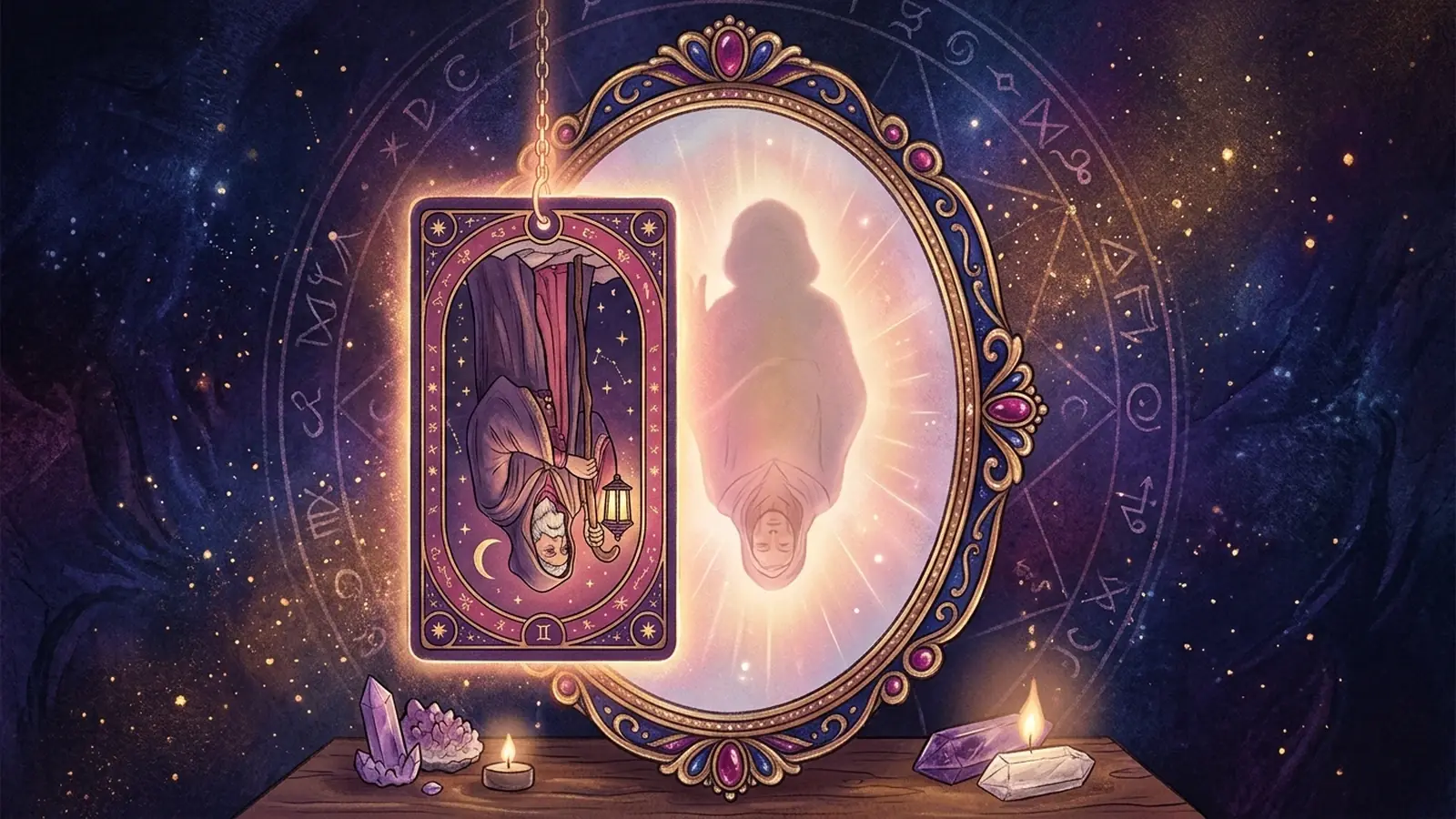
No, a reversed tarot card does not mean bad luck. A reversal usually shows the card's energy blocked, delayed, turned inward, or pushed out of balance, and a few cards even become more hopeful when reversed. Whether a reversal feels difficult depends on the card, the position and the question, not on the fact that it landed upside down.
This guide explains the main ways readers interpret reversed cards, how to choose an approach and stick with it, and gives a one-line reversed meaning for each of the 22 Major Arcana, consistent with the card pages on this site.
Why reversals feel scary, and why that is misleading
Reversals feel ominous mostly because an upside-down image looks like something has gone wrong, but in practice a reversal changes how a card's theme is showing up rather than turning it into its opposite. Reversed meanings have a long history in tarot reading; A. E. Waite's The Pictorial Key to the Tarot (1910), which accompanied the widely used Rider-Waite deck, gave a reversed meaning for every card. Many of those meanings describe delay, weakness or excess, not disaster.
A simple way to think about it: the upright card names the theme, and the reversal tells you something about how that theme is moving. The Sun reversed is still the Sun. Our card page describes it as more like a cloudy day than a storm.
Five common ways to read a reversed card
Readers do not all use one system; most rely on a few overlapping approaches and pick the one that fits the question. These are the most common.
Blocked or delayed
The blocked reading treats a reversal as the upright energy being held back or slowed down. The World reversed, for example, suggests a cycle that is nearly finished but stuck at the last step. This is the most practical approach for timing questions: the answer is often "not yet" rather than "no."
Turned inward
The inward reading treats a reversal as energy that is happening inside you rather than in the outside world. The Hermit upright is chosen solitude; reversed, it can point to loneliness or withdrawal that you have not admitted to anyone. This approach is helpful when a reading is about feelings, self-image or a decision you keep circling.
Too much or too little
The excess-or-lack reading treats a reversal as the upright quality pushed to an extreme in either direction. The Emperor reversed can mean rigid control or a complete lack of structure. The Fool reversed can mean a reckless leap or a refusal to leap at all. When you use this approach, ask yourself which side you are on, since the card alone will not tell you.
Release or clearing
Some reversals read as relief, because the upright card describes something heavy and the reversal shows it loosening. On our card pages, The Devil reversed is about breaking free from an unhealthy pattern, and The Moon reversed is about confusion starting to clear. This is a good reminder that "reversed" and "negative" are not the same thing.
Reading without reversals
Many experienced readers do not use reversals at all, and that is a legitimate choice. They turn every card upright and let the position and the surrounding cards show whether a theme is flowing well or badly. If reversals make you anxious, or you are still learning the 78 upright meanings, reading all cards upright is a sensible place to start.
How to choose an approach
The most important rule is to decide how you will read reversals before you shuffle, not after you see the cards. If you decide afterwards, it is too easy to pick whichever interpretation you prefer, and the reading stops telling you anything new.
Some practical guidelines:
- Pick one main approach for beginners. "Blocked or delayed" is a good default because it works for most questions.
- Let the question guide you. Timing questions suit the blocked reading; emotional questions often suit the inward reading.
- Read the card's own reversed meaning. Each card has a typical reversed pattern, and the table below summarizes them.
- Look at the whole spread. One reversal among upright cards is a single area of friction. Many reversals together often suggest a period of inner work or a situation that is not ready to move.
- Don't reshuffle to remove reversals. If you have decided to use them, keep what you drew.
When a reversal does point to real difficulty
Some reversals do describe genuine problems, and it helps to name them plainly rather than soften everything. Justice reversed can point to unfairness or dishonesty. The Tower reversed often describes a necessary change that is being avoided, with tension building in the meantime.
Even then, a reversal describes a pattern, not a punishment or a fixed outcome. The useful question is "what is this card asking me to notice or change?" A difficult reversal is information you can act on. If a reading touches health, money or legal matters, use it to clarify how you feel, then take the practical question to a qualified professional.
Reversed meanings of the 22 Major Arcana
The table gives a one-line reversed meaning for each Major Arcana card, based on the reversed descriptions on our individual card pages. Use it as a starting point, then read the full page for love, career and yes-or-no nuances.
| Card | Reversed, in one line |
|---|---|
| The Fool | A beginning off balance: either a careless jump with no plan or a freeze where you never jump. |
| The Magician | Power misused or unused: spin and manipulation, or talent left scattered. |
| The High Priestess | Intuition drowned out by noise, or a gut feeling you keep overriding. |
| The Empress | Care out of balance: self-neglect, smothering others, or a creative dry spell. |
| The Emperor | Authority hardened into control and stubbornness, or collapsed into no structure at all. |
| The Hierophant | Rules that feel like a cage, and a push to find beliefs that are your own. |
| The Lovers | Harmony breaking down through mismatched values, temptation or a choice you keep avoiding. |
| The Chariot | The reins slip: scattered direction, stalled plans, or drive turning into aggression. |
| Strength | Inner steadiness wavering into self-doubt, frustration or emotions taking over. |
| The Hermit | Solitude that has turned into loneliness, avoidance or overthinking. |
| Wheel of Fortune | A downswing or delay, and a question about what you can and cannot control. |
| Justice | The scales tip: something unfair, the truth bent, or responsibility dodged. |
| The Hanged Man | A useful pause that has become a stall, or sacrifice with nothing changing. |
| Death | Holding on to what is already over, which is what makes the transition painful. |
| Temperance | Something tipped into excess or conflict; time to slow down and rebalance. |
| The Devil | Starting to see the pattern clearly and take your power back, though the pull may linger. |
| The Tower | Bracing against a change already underway, or a slower, more internal shake-up. |
| The Star | Hope still there but harder to see, dimmed by discouragement or exhaustion. |
| The Moon | The fog lifting: hidden truths surface and anxieties lose their grip. |
| The Sun | Good news behind a few clouds: delays, overconfidence or low spirits. |
| Judgement | Self-criticism, regret or fear keeping you from answering a call to change. |
| The World | Close to the finish line, with a step skipped or closure still missing. |
Read down the list and you will notice how few of these describe misfortune arriving from outside. Most describe something inside the situation that is stuck, overdone or not yet faced, which is exactly why reversals are useful in a reading. All 78 cards, with upright and reversed meanings, are listed on the Tarot Card Meanings page.
A quick way to practise reading reversals
The fastest way to get comfortable with reversals is to draw one card a day with reversals switched on and write two lines about it. First write the upright theme in a few words. Then write how that theme might be blocked, turned inward or out of balance in your own day. Over a few weeks you will build your own sense of each card's reversed side, which is more reliable than memorizing a list.
When you draw cards on this site, reversed cards appear as part of the draw, and each card links to its full meaning. Drawing and reading card meanings is free and needs no sign-up.
Frequently asked questions
What does it mean when all cards in a tarot reading are reversed?
A spread full of reversed cards usually suggests a situation that is stalled, turned inward or not ready to move yet, rather than a run of bad luck. Read the cards for what is blocked or delayed, and check that the deck was not partly flipped during shuffling, which can produce clusters of reversals by accident.
What is the most feared tarot card?
Death and The Tower are the most feared tarot cards, but neither predicts a literal death or disaster. Death usually means a chapter ending, and The Tower a sudden change to something unstable; reversed, Death often shows resistance to an ending that has already begun.
Should beginners read reversed cards?
Beginners can skip reversals at first and read every card upright, then add reversals once the upright meanings feel familiar. Whichever way you choose, decide before you shuffle and keep the same rule for the whole reading.