Oracle Cards vs Tarot: Key Differences & How to Use Them Together
- Fixed structure or free theme: how the two decks differ, when to use each, and a simple way to combine them
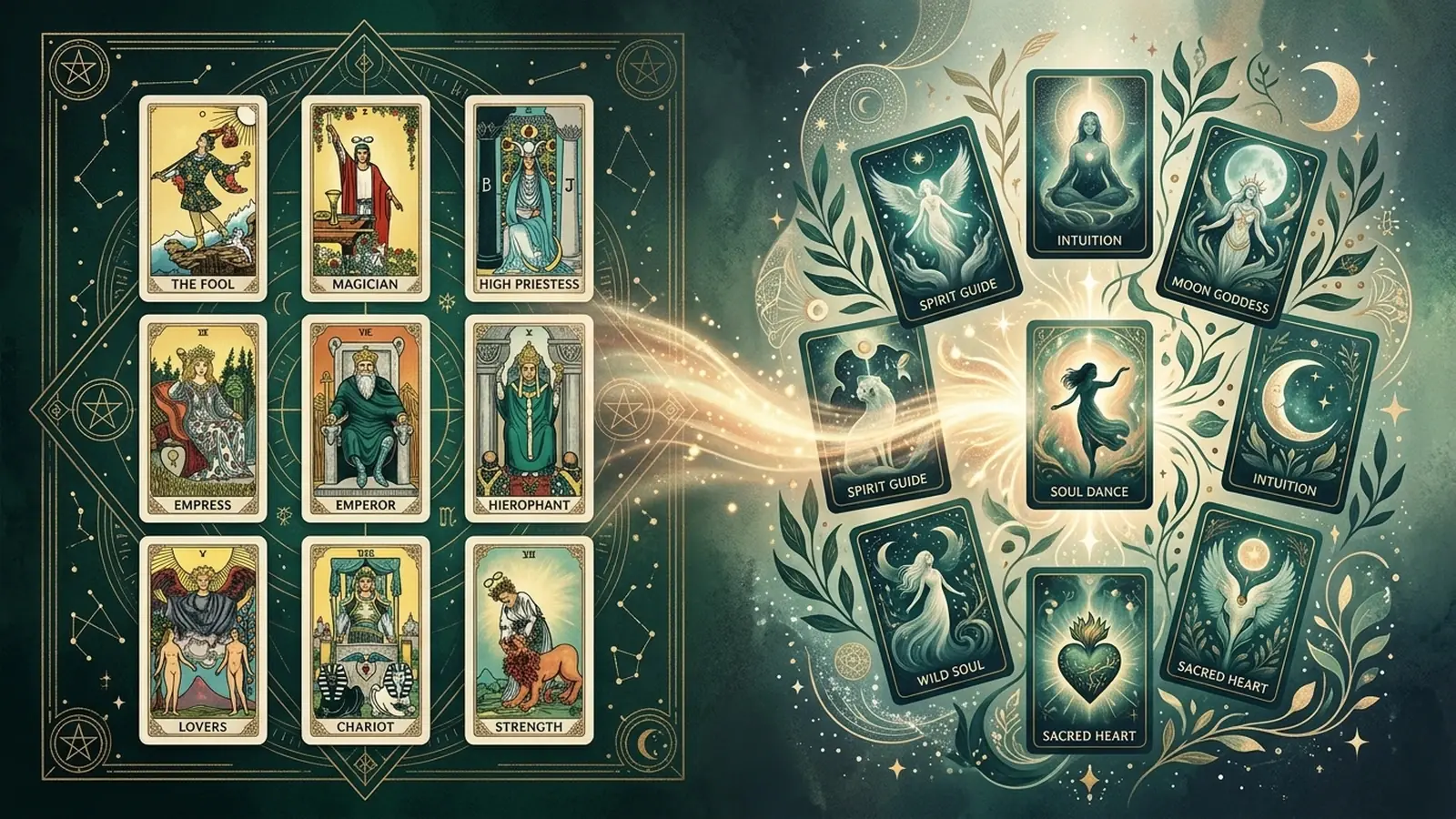
The main difference between oracle cards and tarot is structure: tarot is a fixed system of 78 cards with set suits and meanings shared across decks, while each oracle deck is a self-contained set whose number of cards, themes and messages are decided by its creator. Tarot is better for exploring a complicated situation in detail; oracle cards are better for a single, direct message or theme. Many readers use both, laying out a tarot spread first and then drawing one oracle card as an overall theme or piece of advice.
This guide compares the two side by side, explains when each one is the better choice, and shows a simple way to combine them.
The short answer: a shared language versus a single voice
Tarot works like a shared language, and an oracle deck works like one author's voice.
Because tarot decks follow the same structure, a reader who knows one deck can read almost any other. The Three of Swords means heartbreak whether it is painted in watercolor or drawn as a cat. Oracle decks don't share a structure. A card called "Patience" in one deck has no counterpart in another, and its meaning comes from that deck's guidebook and artwork.
Neither approach is more "real" or more powerful. They are different tools, and the better one depends on what you are asking.
How tarot is structured
A standard tarot deck has 78 cards divided into the 22 Major Arcana and the 56 Minor Arcana, and that structure carries much of the meaning.
- The Major Arcana are named cards such as The Fool, The Lovers and Death. They describe big themes and turning points.
- The Minor Arcana are four suits of 14 cards each: Cups (feelings and relationships), Pentacles (money, work and the body), Swords (thought and conflict) and Wands (drive and creativity). Each suit runs from Ace to Ten, plus four court cards.
- Spreads give each card a position, such as past, obstacle or advice, so the same card can be read differently depending on where it falls.
- Reversals are used by many readers: a card that lands upside down can show its energy blocked, delayed or turned inward.
Most English-language tarot imagery today traces back to the Rider-Waite-Smith deck, illustrated by Pamela Colman Smith to the instructions of Arthur Edward Waite and published in 1909. It was among the first decks to give every Minor Arcana card a full illustrated scene, which is a large part of why tarot can be read from the pictures as well as from memorized meanings. If you want to look up individual cards, our Tarot Card Meanings library covers all 78.
How oracle cards work
Oracle decks have no fixed size, suits or system; each one is designed around its creator's chosen theme.
One deck might be built around angels, another around animals, moon phases, flowers or affirmations. Card counts vary from deck to deck. Many oracle cards print a keyword or short message directly on the card, so the meaning is visible at a glance, and most come with a guidebook that explains each card in the creator's words.
Oracle readings also tend to be simpler. A single card is the most common draw, and many decks are meant to be read upright only, though some readers apply reversals anyway. The tone is usually gentle and encouraging, which suits reflection and daily intention-setting more than detailed analysis.
Oracle cards vs tarot at a glance
The table below summarizes the practical differences.
| Tarot | Oracle cards | |
|---|---|---|
| Number of cards | 78 in a standard deck | Varies by deck |
| Structure | 22 Major Arcana, 56 Minor Arcana in four suits | Set by the deck's creator; no shared system |
| Meanings | Broadly shared across decks | Specific to each deck and its guidebook |
| Typical reading | Multi-card spreads with positions | Often one to three cards |
| Reversals | Commonly used | Optional; many decks read upright only |
| Learning curve | Steeper, but transfers between decks | Gentle, but each new deck starts fresh |
| Best for | Detailed situations, choices, relationships, timing | A theme, an affirmation, a daily message |
| Typical tone | Can be blunt, including hard cards | Usually supportive and encouraging |
When to choose tarot
Choose tarot when your question has several moving parts and you want to see how they relate.
Tarot is well suited to relationship questions where both people's positions matter, to decisions with clear options, and to situations where you want to see causes and obstacles rather than just a mood. Its difficult cards are part of its value. A deck that can show conflict, loss or self-deception is more likely to name the thing you are avoiding.
For a detailed picture, a spread such as the Celtic Cross Spread lays out ten positions covering the present, challenges, influences and possible direction. For a lighter question, a single card or three-card draw is enough.
When to choose oracle cards
Choose oracle cards when you want one clear message rather than an analysis.
Oracle decks fit well at the start of the day, before meditation or journaling, or at moments when you already know the facts and need a reminder of how you want to approach them. Because the message is often printed on the card, you can read it without any study, which also makes oracle decks a common first step for people new to cards.
The trade-off is depth. An oracle card rarely tells you why a situation is stuck or what the other person might be weighing. If you find yourself drawing card after card to get more detail, that is usually a sign the question needs tarot. To try a draw, the Free Oracle Card Reading lets you pick a deck and draw one card.
How to use oracle and tarot together
The simplest combined method is to read a tarot spread for the details, then draw one oracle card as the overall theme or advice.
- Ask one question. Write it down so both decks are answering the same thing.
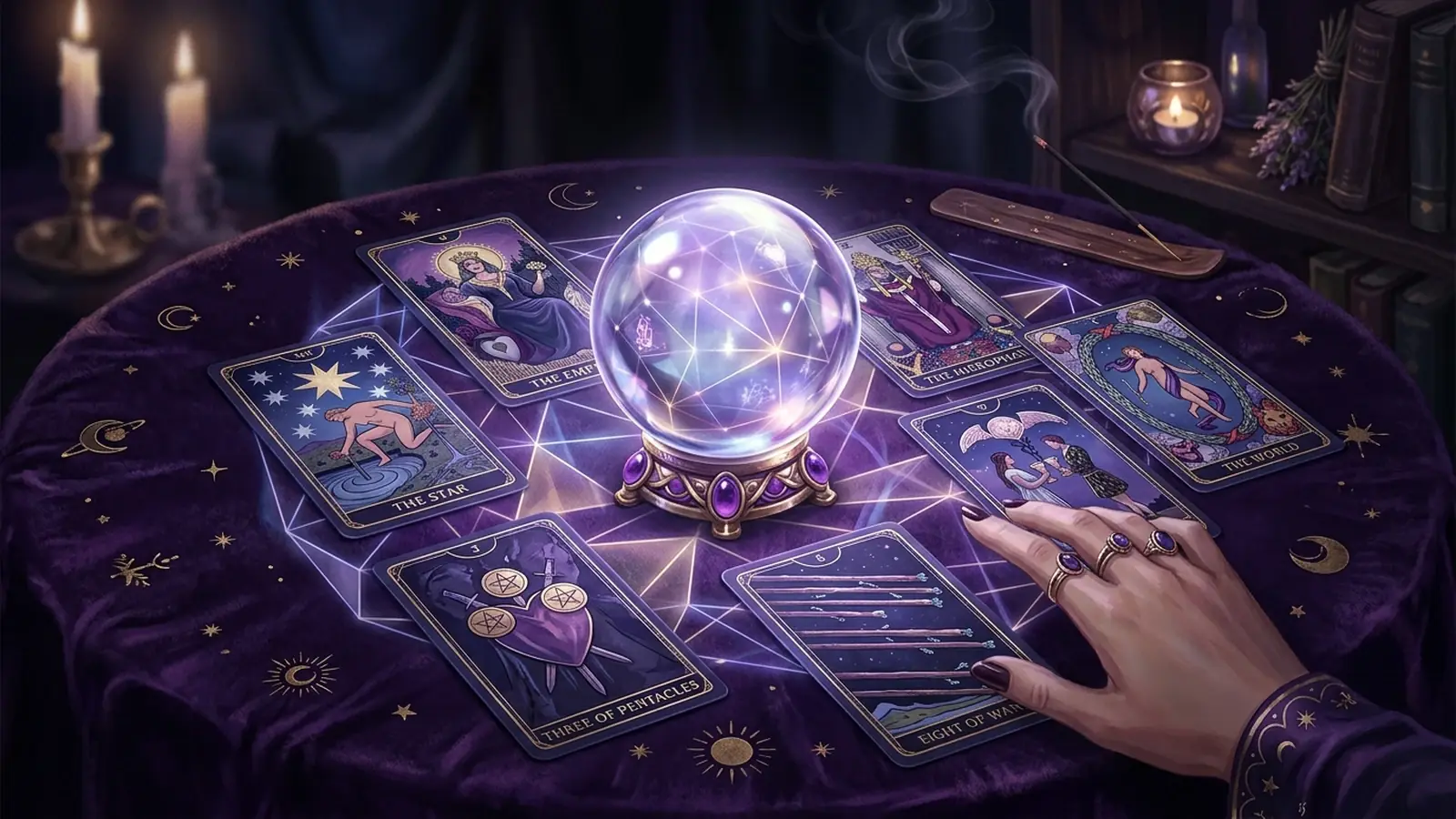
- Lay out the tarot spread. Three cards (situation, obstacle, advice) is a good starting size. Read each card in its position.
- Summarize the tarot in one sentence. For example: "I'm holding on to a plan that no longer fits, and the advice is to make a clear decision."
- Draw one oracle card. Read it as the attitude to bring to that summary, not as a new answer to the question.
- Check for agreement. If the oracle card echoes the tarot, take it as emphasis. If it seems to contradict it, ask how both could be true; the contrast often points to the part you are resisting.
Some readers reverse the order and draw an oracle card first to set the theme, then use tarot to explore it. Both orders work. What matters is giving each deck a defined job so you don't keep drawing until you get the answer you hoped for.
Common questions
What's better, tarot or oracle cards?
Neither is better overall: tarot is better for exploring a complicated situation in detail, and oracle cards are better for a single, direct message. Many readers use both, a tarot spread first and then one oracle card as a theme.
Can I use oracle cards like tarot cards?
Partly. You can lay oracle cards in spread positions and read them one by one, but oracle decks have no shared suits, numbers or meanings, so each card is read from its own deck’s guidebook rather than from a common system.
What are oracle cards good for?
Oracle cards are good for a daily theme, an affirmation, or a reminder of how you want to approach something you already understand. Because the message is often printed on the card, they are also an easy first deck for beginners.
How often should you pull an oracle card?
Once a day, or once per question, is enough. Drawing again until you get a message you like turns the card into a coin toss.
Can oracle cards answer yes or no questions?
They can give a lean, but tarot is usually clearer for yes or no questions because its cards have well-known positive and negative tendencies. A dedicated yes or no reading explains how to phrase the question and which cards lean each way.
Is one more accurate than the other?
Neither has been shown to predict events, so accuracy is not a useful way to choose between them. Both are tools for reflection, and the better one is the one whose structure fits your question.
Do I need to learn tarot before using oracle cards?
No. Oracle decks are designed to be read directly from the card and guidebook. Learning tarot afterwards is easy to add, since the two don't conflict.